A critique of the documentary hypothesis
Summary: This essay argues that the Torah is a divine text written by Moses at God’s command, and it rejects higher biblical criticism which claims the Torah was composed from multiple human sources (J, E, P, D) and edited much later. It critiques the documentary hypothesis on several grounds: the absence of any ancient Jewish tradition mentioning multiple Torah versions, the improbability that a nation would accept a newly-composed scripture, and the implausibility of a Redactor weaving together separate sources without any record of him doing this. Archaeological, historical, and biblical evidence is presented that Israelites in the early biblical period possessed a known “book of the Torah” and practiced its laws, implying a continuous tradition rather than a late composition. Drawing on the scholarship of Umberto Cassuto, the essay argues that variations such as the divine names YHWH and Elohim reflect theological nuance and literary purpose, and not multiple authors. Ultimately, the essay maintains that the Torah’s coherence, literary sophistication, fulfilled prophecies, and the historical survival and restoration of the Jewish people support its divine origin rather than human compilation.
My riveting book that explains our current world
"The Struggle for Utopia - A History of Jewish, Christian and Islamic Messianism" by Arnold Slyper. Wonderful reviews. Available on Amazon, at US bookstores, and at Pomeranz Bookseller in Jerusalem (with courier service available). " Brilliant and thought-provoking."
The question as to who wrote the Torah is one of the most contentious issues in the study of the Torah, and many weighty issues hang on the answer.
The premise of this book is that the Torah is a divine composition dictated by God to Moses and written down by him. This is, after all, what the Torah states after the Israelites arrived at Mount Sinai:
And Moses wrote all the words of YHWH, and rose early in the morning, and built an altar at the foot of the mountain, and twelve pillars, according to the twelve tribes of Israel (Exodus 24:4).
The Book of Deuteronomy also says:
And so it was, when Moses finished writing the words of this Torah onto a book until their conclusion, that Moses commanded the Levites, the bearers of the Ark of the Covenant of YHWH, saying: “Take this book of the Torah, and place it at the side of the Ark of the Covenant of YHWH, your God, and it shall be there for you as a witness" (Deuteronomy 31:24-26).
It is unclear from this first quotation from Exodus how much of the Torah Moses wrote down at Mount Sinai, since the bulk of the Torah had not yet been transmitted. However, the second quotation from the Book of Deuteronomy could refer to the entire Torah.1
An alternative and popular view in academic and other circles is that the Torah is a human composition. Higher biblical criticism considers the entire Torah to have been composed by different authors writing during different historic periods.
Strong support for this hypothesis is provided by duplications and contradictions in the early stories of Genesis. For example, there are two different creation accounts and there are significant differences between the two. Two flood stories are intertwined between each other to form a single account. Abraham and Sarah are told separately that they will bear a son in their old age. God establishes two covenants with Abraham — the Covenant between the Pieces and the Covenant of Circumcision. Moses was told by God that that His name YHWH was not known to the forefathers (Exodus 6:3), yet this name is mentioned to them multiple times in the Book of Genesis.
The notion that the Pentateuch is derived from different sources was first proposed in the mid-eighteenth century. The writing of Julius Wellhausen in the late 19th century was central to the development of higher biblical criticism. In his influential book "Prolegomena to the History of Ancient Israel" (1878), he brought together earlier scholarship and proposed that the Torah was derived from four main sources — a J or Yahwist source, an E or Elohist source, a P or Priestly source, and a D or Deuteronomist source.2 These sources were later woven together by editors or a single redactor to form the Pentateuch we recognize today.
It is noteworthy that higher biblical criticism was initially a Christian project. The New Testament gospels were written by four authors, and contain many contradictions. Nevertheless, this never invalidated their writings, as Christians do not generally view the New Testament as the direct word of God. Higher criticism of the Jewish Bible equalized these two works in terms of their religious authority.
The four sources for the Pentateuch proposed by Wellhausen
Each of the four sources in the system of Wellhausen presents a full and independent account of the history of Israel, and just as crucial — to the development of the religion of ancient Israel. Each document also possesses its own theology, politics, language, and style.3
The J or Yahwist source is the earliest of the four sources and is presumed to have been written by scribes in the court of the southern Kingdom of Judah in the early monarchical period, in about 950 BCE. It is characterized by vivid, anthropomorphic descriptions of God. It uses YHWH as the name of God from the very beginning of the Torah. Thus, the second creation account is the first J source.
The E or Elohist source arose later in the Northern Kingdom of Israel and is dated by most scholars to the eighth century BCE. It was probably woven together with the J source after the fall of the Northern Kingdom in 722 BCE, possibly by scribes from the southern kingdom of Judea. This fusion of E and J sources has been termed by some scholars the JE narrative.
The E source emphasizes divine majesty and focuses on prophecies, dreams, angels, and divine promises. The first mention of the name YHWH in an E source is when God reveals this name to Moses at the burning bush in chapter 3 of the Book of Exodus, and the name Elohim is employed prior to this time. Genesis chapters 20 to 22, where Abraham interacts with God using mainly the name Elohim, and which includes the expelling of Hagar and Ishmael from Abraham’s home, are considered to be an E source.
The D or Deuteronomist source comprises the main part of the Book of Deuteronomy and it emphasizes religious reform and law codes. It was composed by scribes in the southern kingdom of Judah during the reign of King Josiah in the late seventh century or early sixth century BCE and a copy of this “Book of the Law” was discovered in the Temple during his reign (2 Kings 22 and 2 Chronicles 34).
The P or Priestly source is thought to have been written by Temple priests in about the sixth century BCE during the Babylonian Exile (587–539 BCE), although some scholars suggest it was compiled and completed in the early Second Temple period when the exiled Jewish community had already returned to Judea under Persian rule. The P source focuses on ritual, genealogy and priestly matters and reflects a concern for order and ceremony. It emphasizes the transcendent and majestic nature of God. The name YHWH is not mentioned in this source until the time of Moses.
The P source is evident in the creation account of Genesis 1, which presents a structured and orderly depiction of God's creation over six days. The Noah account is a blend of J and P sources. The P source is prominent in the detailed instructions for construction of the Tabernacle (Exodus 25-31) and the description of its rituals and furnishings (Exodus 35-40). These passages focus on the importance of proper worship and the role of the priests. The entire book of Leviticus is heavily influenced by the Priestly source with its detailed laws and regulations concerning sacrifices, rituals, purity, and the responsibilities of the priests, and also sections of Numbers, particularly those dealing with census data, genealogies, and rituals related to the priesthood such as the consecration of the Levites and laws governing the priesthood. Scholars have identified elements of the P source throughout the Torah where there are detailed legal or ritualistic instructions, covenants, lists of genealogies, and narratives that emphasize the importance of proper worship and adherence to religious laws.
The documentary hypothesis assumes that the Pentateuch was redacted during or shortly after the Babylonian exile (586–539 BCE), although the process may have continued over an extended time. A need was felt at that time for consolidation of the traditions and sources of Israelite history and law so as to provide a coherent religious narrative and legal foundation for the Jews. Earlier dates for the redaction have also been suggested.
It should be mentioned that over the last century some scholars have raised questions about the viability of the documentary hypothesis, and a modified version of this hypothesis has been suggested that looks only at problem areas rather than the totality of the Torah text.4
Initial critiques of the redaction and composition of different Torah sources
The documentary hypothesis has been accepted by many biblical scholars, but it is an anathema to Orthodox Jews because it removes divine authority from the Bible and replaces it with, at the most, divine inspiration. God is no longer the source of the ethical imperatives of the Torah. Rather, its ethics are cultural and human-derived.
Proving that the Torah was dictated by God to Moses is impossible and is a matter of faith. Nevertheless, it is possible to frame the question in a different way and ask how feasible it is that God dictated the Torah? If it is unlikely that He dictated it as described in the Torah, then belief in its Divine authorship is unreasonable. However, if there is no logical contradiction, then there is no logical challenge to faith. This is far from being a proof, but may be sufficient for many believers.
This is why I focus in a later chapter on the historical veracity of the Exodus from Egypt. If there truly was an historical Exodus, then a revelation at Mount Sinai could have happened. If, on the other hand, the historicity of the Exodus is in doubt, then we are in murky territory. This topic is discussed in my essay “The Egyptian Exodus – fact or fiction?”
Another issue relates to the script available to Moses. If the only script available to him with which to write his book was hieroglyphics, then it is unlikely that the Torah could have been transmitted from generation to generation, since few, if any, Israelite would have been able to read it. In my essay “With what script did God write the Ten Commandments?”, I advance the notion that the Israelites at that time were familiar with the phonetic proto-Sinaitic script and brought it with them to Canaan. This script enabled the creation of a predominantly literate Israelite society.
A first-hand account of divine revelation could be considered strong evidence. In fact, the Torah describes the entire nation assembled at Mount Sinai and receiving the Ten Commandments. There is nothing equivalent to this claim for any other holy document from any other faith:
On the third day, when morning came, there were thunders and lightnings, a thick cloud upon the mountain, and an exceedingly loud blast of the shofar; and all the people in the camp trembled. Moses brought the people out of the camp to meet God, and they stood at the foot of the mountain (Exodus 19:16–17).
This revelation involving all the people is also described in the Book of Deuteronomy:
You came near and stood at the foot of the mountain... Then YHWH spoke to you out of the midst of the fire. You heard the sound of words, but saw no form; there was only a voice. And He declared to you His covenant, which He commanded you to perform, the Ten Commandments, and He wrote them on two tablets of stone" (Deuteronomy 4:11–13).
Deuteronomy specifically mentions that “all the assembly” experienced this revelation and not just a select group of the people (Deuteronomy 5:22).
Mount Sinai is also mentioned in a number of other places in the Bible, including the Book of Judges (Judges 5:5), still an early biblical source, and the Book of Nehemiah, which is a relatively late biblical source (Nehemiah 9:13).5
Another important point is that God has no physical form, and in the Bible He is experienced almost entirely in an auditory manner. By contrast, in the pagan world, deities were experienced visually. Hence the importance of graven images. In an auditory-type system, a book becomes essential as a means of recreating the experience of God.
The documentary hypothesis and the names of God
God’s names serve as key markers in the documentary hypothesis for distinguishing the sources of the Torah. The Yahwist (J) source consistently uses the divine name YHWH from the beginning of the Torah and portrays Him in personal and anthropomorphic terms. The Elohist (E) source depicts Elohim as transcendent and communicating through dreams or intermediaries and uses the name Elohim until the divine name YHWH is revealed. The Priestly (P) source also uses the name Elohim prior to God’s second recruitment speech of Moses in Exodus 6:2–3, but subsequently changes to YHWH. This reflects a structured theology of progressive revelation. Thus, alternations between YHWH and Elohim are not random, but provide a central clue for identifying each source and its distinctive theology and narrative style.
Based on the work of Cassuto, I introduced in the previous chapter an alternative explanation for why the Torah uses different names for God, and which, in my view, nullifies the explanation of the documentary hypothesis.6 In brief, the names of God reflect the nature of His relationship with either the forefathers or the Israelite nation. YHWH is an immanent God who desires close relationships with humanity, while Elohim is a transcendent God who is more distant is His relationships but who nevertheless remains concerned about the providence of the world.
An illustrative example in the Torah relates to animal sacrifices. A sacrifice is a means of drawing close to God and in the Bible is invariably offered to YHWH. Thus, Noah builds an altar to YHWH following his rescue from the flood (Genesis 8:20), even though it was Elohim who instructed him to leave the ark several verses previously (ibid 8:15).
However, there is a single exception to this rule in the Torah:
Jethro, the father-in-law of Moses, took an olah-offering and peace-offering for Elohim, and Aaron and all the elders of Israel came to eat bread with the father-in-law of Moses before Elohim (Exodus 18:12).
The entire passage in Exodus 18:1–27 recording Jethro’s visit is widely recognized by proponents of the documentary hypothesis as a non-Priestly narrative that is primarily E (Elohist), with some editorial touches from the J (Yahwist) source or the redactor (R). Other scholars consider the original E story to have ended at verse 12 and the subsequent judicial advice (verses 13–27) to have been added later by the redactor, possibly using J or Deuteronomic material to connect the episode with later Sinai legislation.
But there is a much simpler explanation. This sacrifice would normally have been expected to be offered to YHWH. However, as a priest of Midian, Jethro’s approach to God was to a universal, transcendent God, best described by the name Elohim. This is why Jethro greeted Moses by saying:
“Now I know that YHWH is greater than all the deities, for with the thing that they planned, [He came] upon them” (Exodus 18:10).7
But would it not have been more appropriate for Jethro to say that YHWH is the only deity? Jethro’s concept of the deity he worshipped was sufficiently different from that of his son-in-law Moses, a prophet of YHWH, that Moses felt himself unable to attend this first recorded ecumenical event in human history. This could explain why Moses’ name is absent from among the guests at the sacrificial meal —" only Aaron and all the elders of Israel” were present.8
My argument regarding the relevance of the names of God depends on recognizing that many of the early stories in the Book of Genesis are allegories, sometimes loosely based on well-known mythological accounts. However, if there really was a massive flood that wiped out most of mankind, then it would be understandable that different survivors would have related this historical event story in different ways and with minor contradictions, as would be the case with any historical account of events long past. However, once one accepts that a global flood never occurred and is not an historical fact, then another question becomes — why did two sources compose essentially the same allegory, differing only in minor differences? The documentary hypothesis will have no answer this question.
Lack of external evidence for different sources
The documentary hypothesis is based entirely on a literary analysis of the Masoretic text and has no external support. By comparison, the New Testament is composed of writings derived from multiple sources. The Qur’an contains adaptations of biblical stories that can be found in the Torah and different midrashim. By comparison, none of the sources postulated by the documentary hypothesis have ever been found, including among the Dead Sea Scrolls.
No Jewish source ever makes mention of different circulating versions of the Torah, other than the book of Deuteronomy, which the Torah itself says was written by Moses and which was never claimed to have been written by God. It is true that there are different textual traditions, such as the Samaritan Pentateuch and the Septuagint, but the differences between them are relatively minor.
It is not as if there was any large lacuna in Jewish history during which different versions of the Torah could have circulated. There are no such lacunae, and the whole of Jewish history is well documented in the Tanach (the Old Testament) from the time of the Exodus up to the period of Nehemiah.
The Talmud discusses the authorship of the various biblical books, but no mention is ever made of the possibility that the Torah may have authors other than Moses, except for its last few sentences.9 These sentences could not have been written by Moses, since he had already died.
It is clear from the Tanach that a book containing the Torah was familiar to Israelites in the period of the Judges and early monarchy. The beginning of the book of Joshua quotes a speech by Joshua that explicitly makes this point:
O that you will strengthen yourself and persevere very much in order to observe, to do, according to all of the Torah that Moses my servant has commanded you. Do not deviate from him to the right or to the left that you may succeed wherever you may go. This book of the Torah is not to leave your mouth (Joshua 1:7-8).
Also, when the Children of Israel were on Mount Ebal at the time of Joshua:
Then Joshua built an altar to YHWH the God of Israel on Mount Ebal as Moses, the servant of YHWH, commanded the Children of Israel, as it is written in the book of the Torah of Moses (Joshua 8:31).
The passage continues:
He [Joshua] inscribed there on the stones a copy of the Torah of Moses, which he wrote before the Children of Israel” (ibid 8:32). Afterwards, “he read all the words of the Torah, the blessings and the curses, according to all that is written in the book of the Torah (ibid 8:34).
Another example is found in 2 Kings 14:6 and 2 Chronicles 25:4, which refer to a law written in “the Book of the Torah of Moses.” In both cases, Deuteronomy 24:16 is cited regarding children not being put to death for their parents.
Ezra is described as being “a scribe skilled in the Torah of Moses” (Ezra 7:6). In Nehemiah 8, Ezra reads from “the Book of the Torah of Moses” in a public Torah reading. In Nehemiah 13:1 “The Book of Moses was read in the ears of the people,” and this section quotes Deuteronomy 23:4–5 regarding the prohibition on an Ammonite and Moabite forever entering the congregation of Israel. Daniel 9:11 and 13 refer to curses written “in the Torah of Moses the servant of God,” corresponding to Leviticus 26 and Deuteronomy 28. Malachi 3:22, the last of the prophets, states: “Remember the Torah of Moses My servant, which I commanded him at Horeb.”
All these quotations assume one Torah comprising the four books of Moses plus Deuteronomy, and no mention is ever made of different versions of the Torah of Moses.
Laws mentioned in the Torah were also practiced during this period, suggesting the existence of a transmitted tradition.
A few examples:
The prophet Samuel wished to eradicate the nation of Amalek as proscribed in Exodus 17:2-16 and Deuteronomy 25:17-19. He was also aware that this was to be more than a more act of vengeance and that everything belonging to Amalek needed to be destroyed as an offering to God:
And Samuel said to Saul: “. . . So said the Lord of Hosts: ‘I remember that which Amalek did to Israel, what he did to him on the way, when he came up out of Egypt. Now go and you shall smite Amalek, and you shall utterly destroy all that is his, and you shall not have pity on him; and you shall slay both man and woman, infant and suckling, ox and sheep, camel and ass’” (1 Samuel 15:1-3).
Excavations at Shilo in Samaria where the Tabernacle was placed indicate that a courtyard there had the same dimensions as that described for the Tabernacle in the desert. The courtyard of the Tabernacle is described in Exodus 27:18 as measuring 100 cubits long by 50 cubits wide, with the Tabernacle being contained within it. On the northern plateau of the tel at Shilo was found a large rectangular, flat, rock-cut area measuring 50 meters × 27 meters (roughly 100 × 50 cubits, assuming a cubit equals 0.5 meters), corresponding strikingly to the dimensions of the Tabernacle courtyard.10
It is evident from 2 Samuel 24:1–10, and the parallel account in 1 Chronicles 21:1–8, that King David’s general Joab knew that it was religiously problematic to take a direct census of the Israelite nation, and he protested when David ordered him to do so:
And Joab said to the king: “May the Lord your God add to the people a hundredfold, as many as they are, while the eyes of my lord the king still see it; but why does my lord the king desire this thing?” (2 Samuel 24:3).
1 Chronicles 21:6 relates that Joab refused to count the tribes of Levi and Benjamin, apparently recognizing their special status and attempting to minimize the risk involved. The census did indeed result in a plague that killed 70,000 Jews (2 Samuel 24:15). The Torah does not forbid a census outright, but prescribes a special procedure as how it should be done, using a donation of a half-shekel per person so that individuals are not counted directly:
YHWH spoke to Moses saying: “When you will take a census of the Children of Israel to count them, each one must give to YHWH an atonement for his soul at the time he is counted. Then no plague will come upon them when counting them. This is what they shall give — everyone who passes among the counted — half of the shekel. . . (Exodus 30:12-13).
A final example comes from the Book of Ruth. Ruth gleans fallen stalks (leket) during the harvest from Boaz’s field. Leket is described in the Book of Leviticus:
“…neither shall you gather the gleanings (leket) of your harvest” (Leviticus 19:9)
and also:
When you reap the harvest of your land, you shall not reap to the edge of your field or gather the gleanings of your harvest; you shall leave them for the poor and the stranger (Leviticus 23:22).11
Nevertheless, one could well ask whether extra sections were added to the Torah by prophets or priests, particularly to the narrative sections, and especially at a time when there was little general knowledge of the Torah text and few people would have been aware of what was happening?
There would have been a strong disincentive to do this. According to the Torah itself, revision of the text is prohibited. The following is the primary biblical verse cited in halakhic sources that forbids textual alterations:
You shall not add to the word that I command you, nor take away from it, that you may keep the commandments of YHWH your God which I command you (Deuteronomy 4:2).12
Even if this verse was interpreted differently, any revisions of the Torah during the Babylonian or Persian periods would have needed to be approved by The Men of the Great Assembly (Anshei HaKnesset Hagdola). This was a group of 120 sages who led the Jewish people at the very end of the biblical period and the beginning of the Rabbinic period, roughly from the late 6th century BCE to the early 3rd century BCE. They were responsible for reestablishing Jewish religious life in Judea after the exile. Jewish tradition attributes to them an important role in the preservation and organization of Jewish religious life and texts. They were the ones who canonized the Hebrew Bible (the Tanach) that we have today. It is unimaginable that they would have put together different texts to create a new Torah without there being some mention of this in Jewish sources.
A further consideration is that the documentary hypothesis assumes that when the redactor finally completed his composition, the Jewish nation readily accepted it. A creative writer could perhaps have composed a new version of the Torah, but for the entire Jewish people to have readily accepted his new composition would have been highly improbable. Moses relied on a dramatic public revelation on Mount Sinai involving the appearance of God amid smoke, thunder and lightning, and the drawn-out sound of the shofar, to convince the people of the authenticity of this revelation.
It is also inconceivable that a redactor would have worked on such a major project during or sometime after the return from the Babylonian exile without there being some mention in the Mishna or Talmud of such a redaction. According to the Talmud, Ezra changed the Torah from an Ivrit to Ashuric script early after the return to Judea so that the people could more readily read it.13 This is a comparatively minor matter compared with joining manuscript sources together to form a totally new Torah.
It is also highly improbable that the Judean Kingdom would have agreed to join manuscripts from the Northern Kingdom with their own. From the time of the separation of the Ten Tribes and their worship of golden calves at Beit El and Dan, the religious standing of the Northern Kingdom was regarded by biblical writers as lower than that of the southern kingdom of Judah and Benjamin.
In sum, the idea that multiple Torah sources were later combined into a single work is very difficult to reconcile with the history of Jewish textual transmission.
Critique of the documentary hypothesis based on the Torah’s literary structure
The documentary hypothesis also falls short when considered in the light of certain literary aspects of the text.
As subsequent chapters will show, there is a continuity in the stories in the Book of Genesis that transcends their presumed sources. In other words, the early stories in the Torah are always leading somewhere.
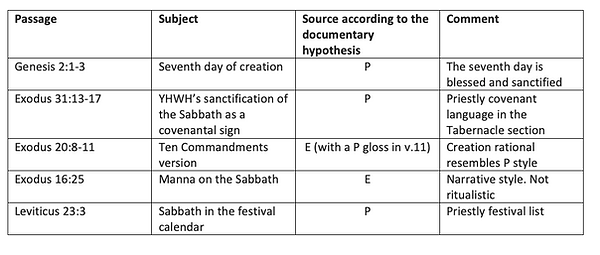
As will shortly be explained, the first creation story constitutes an introduction to holiness and God’s institution of the Sabbath. The documentary hypothesis identifies the first creation story is a P source. One might anticipate, therefore, that further elaboration on the subject of the Sabbath would continue to be attributed to the P source. In fact, the laws of the Sabbath are mentioned subsequently several times in the Torah and are considered to be derived from a mixture of E and P sources. The Ten Commandments, which is a presumed E source, even contain words the words found in the creation account – “YHWH blessed the seventh day and sanctified it.” All this can be summarized as follows:
Passages about the Sabbath and their source according to the documentary hypothesis
It is more logical and simpler to say that the first creation story is introduced by Elohim because it reflects the creative activities of a transcendent Creator. Although the first sentence of the Ten Commandments uses the name Elohim, the subsequent discussion of the Sabbath in the Torah, including the details of the Ten Commandments, relates to YHWH. This is because YHWH is now the national God of the Jewish people, and the Sabbath is the sign of YHWH’s covenant.
Another literary example is provided by the story of Noah. According to the documentary hypothesis, the body of the Noah story is primarily a P source, although it has J verses mixed within it. Each of these two sources can be separated out and each contains more or less the same story, although with notable gaps which are filled by passages attributed to the other source. There are also a few contradictions between these sources — for example, regarding the number of animals brought to the ark.
As will be discussed in the chapter on “The Noah story and the names of God,” there are chiastic structures within this story:
A1. And it came to pass after seven days, that the waters of the flood were upon the earth. (Genesis 7:10, P source ). . . .
B1. And the rain was upon the earth forty days and forty nights” (Genesis 7:17, J source) . . . .
C1. And the waters prevailed upon the earth a hundred and fifty days (Genesis 7:24, P source).
When the flood subsides, everything is reversed, including its timing expressed in days, while retaining the same mixture of J and P sources:
C2. And the waters then receded from upon the earth, receding continuously; and the waters diminished after the end of the hundred and fifty days the waters were abated (Genesis 8:3, P source). . . .
B2. And it came to pass at the end of forty days, that Noah opened the window of the ark which he had made (Genesis 8:6, J source). . . .
A2. And he stayed yet other seven days; and again he sent forth the dove out of the ark (Genesis 8:10, J source). . . . And he stayed yet other seven days; and sent forth the dove; which did not return back to him anymore (Genesis 8:12, J source).
More than this, the entire Noah story constitutes a single large chiasmus, with a complete mixture of presumed J and P sources, with 15 items in each direction (see also “The Noah story and the names of God”).
Could a skillful redactor have joined his sources together to make these types of chiasmi? It is certainly possible. But again, it is far more logical to say that the Noah story was composed as we find it today, with God displaying two of His relational aspects in this story, primarily that of Elohim, but also that of YHWH.
Another example appears at first glance to support the documentary hypothesis, but, on closer examination, turns out to suggest exactly the opposite.
In a recruitment speech made by God to Moses, the Torah relates:
And Elohim spoke to Moses and said to him. I am YHWH. And I appeared to Abraham, to Isaac and to Jacob as El Shaddai, but through My name YHWH I did not become known to them (Exodus 6:2).
However, we know that God appeared to the forefathers many times under the name YHWH because this is explicitly stated in the text!
The continuation of this speech in the Book of Exodus is regarded by the documentary hypothesis as one of the clearest examples in the Torah of a Priestly (P) passage, and it plays a crucial role in distinguishing Priestly theology from Yahwist (J) and Elohist (E) sources. One could therefore say that the passages describing God’s previous appearances to the forefathers under the name YHWH were all from a J source. Hence, there is no contradiction, at least at a source level.
However, we know that a “name” in the Torah means much more than just a word label. For God, it also has the meaning of His attributes. I suggest, therefore, that YHWH in this context means God in His role as the national God of Israel, and this could not yet have been known to the forefathers. More traditional suggestions for interpreting this sentence are discussed in the chapter “God’s two speeches of redemption.”
Now look carefully at the section that follows this speech to Moses.
God made two covenants with Abraham. The Covenant Between the Pieces is considered a combination of E and J sources and uses the name of God YHWH, while the Covenant of Circumcision is considered a P source and uses the names of God El Shaddai and Elohim.
As discussed in detail in the chapter “God’s two speeches of redemption,” this recruitment speech in the Book of Exodus contains wording from both covenants. There is logic to this, since the role of Moses is to bring about the fulfillment of both covenants made to Abraham through the different aspects of God represented by YHWH and Elohim. However, this mixing makes no sense according to the documentary hypothesis.
If the Torah is not a human composition, who wrote it?
The fearful display at the time of the giving of the Torah was designed to impress the people and authenticate Moses as God’s spokesman. The tradition that the entire people left Egypt, witnessed a revelation of God at Mount Sinai, and recognized Moses as His spokesman has been handed down from generation to generation. This is why so many of the rituals of Judaism are specifically related to the Exodus or the revelation at Mount Sinai. This includes Passover, which is observed every year, and the Sabbath which is observed every week.14 Made-up manuscripts describing imaginary events would never have been successfully transmitted in this way.
Another indirect way of assessing whether the Torah is Divine or humanly invented is by analogy with a false prophet. The Torah indicates that one can assess the authenticity of a prophet on the basis of the accuracy of his prophecies:
But the prophet who presumes to speak a word in My name which I have not commanded him to speak, or who speaks in the name of other gods — that prophet shall die. And if you say in your heart, “How shall we know the word which the Lord has not spoken?”. . . When a prophet speaks in the name of the Lord, if the thing does not come about or come true, that is the word the Lord has not spoken; the prophet has spoken it presumptuously (Deuteronomy 18:20, 22).
The Torah is a prophetic book. It follows, therefore, that the authenticity of the Torah can also be judged on the basis of its predictions:
In the Covenant of Circumcision, God promises that His covenant will be “everlasting” and that the land of Canaan will be an “everlasting possession” for the Jewish people (Genesis 17:7-8). In the tochacha (covenant warnings) in the Book of Leviticus, the Torah promises that God will remember His covenant with the Patriarchs and that, after any period of exile, the people will return to their land:
Then I will remember My covenant with Jacob… and I will remember the land… I will not reject them… to annihilate them… for I am the Lord their God (Vayikra 26:42–45).
Similarly, in Deuteronomy:
The Lord your God will return your captivity and will gather you from all the nations. . . (Devarim 30:3).15
The second return after the Babylon exile (the first being from Egypt) began in 538 BCE when the Persian monarch Cyrus the Great issued a decree allowing the Jewish exiles to return to Judea and rebuild the Temple. In our time, we are in the unique position of being able to judge the Torah’s predictions in real time, since we are now witnessing a third redemption.
The Jewish people are the only nation in history that has returned to its ancestral land on three occasions and reestablished a culture almost identical to that from over 3,500 years ago. It is almost as if the land has been waiting for the Jewish people to return. Moreover, no other nation has been able to restore the agricultural productivity of the land as the Jewish people are now doing.16
What is particularly noteworthy about the current redemption of the Jewish people and what, in my view, reinforces its divine nature, is that many of the steps in the formation of the State of Israel could not have been predicted to be successful. In fact, one could well have guessed that the odds were against success. None of these steps can be said to have been miraculous, in that they can all be explained in a rational way. Nevertheless, when viewed together, the formation of the State of Israel can truly be regarded as miraculous.
Two examples among many:
The fate of the Middle East hung in the balance between October and November 1942 during the Battle of El Alamein in the Second World War. A German victory by Field Marshal Erwin Rommel’s Afrika Korps would have meant the end of hopes for a Jewish state. The SS was already prepared in Greece to destroy the remnant of the Jewish people in Palestine. Yet the outcome of this battle may have been very different if Germany had postponed its invasion of Russia and provided Rommel with sufficient men, ammunition and fuel to win the campaign. But destroying Russian Jewry was of the utmost importance to Hitler.
The Six-Day War expanded Israel territorially and provided it with strategic depth. Never before in the history of warfare has a battle against three nations been won in just six days. Israel made a tremendous gamble by carrying out a preemptive attack on Egyptian airfields with almost its entire air force. A number of “coincidences” helped make this successful.17 The Israeli planes were detected by a new Jordanian radar, but the Jordanians were unable to transmit the appropriate warning to Egypt about the Israeli attack. The code had been changed that very morning and the previous code was no longer valid. All Egyptian anti-aircraft units had been ordered to cease fire between 7.00 and 8.00 in the morning because of an air tour arranged over Sinai together with an Iraqi army delegation. This was precisely the time that Israeli pilots set off on their mission. On the evening before the Israeli attack, the Commander-in-Chief of the Egyptian Air Force held a party for his pilots until the early hours of the morning. This delayed a routine reconnaissance mission the next morning. By the time the Deputy Commander reached his planes the attack was over.
In sum, it is reasonable to believe that the Pentateuch is divinely authored. This is not a proof but it represents, in my view, a reasonable alternative. The Torah can therefore function as the basis of ethics for all humanity. The documentary hypothesis was an attempt to understand the Torah as a human composition. If the Torah is understood solely in this way, mankind is left with only a relative guide to good and evil and thus a relative moral code.
I have also shown that there is no external evidence for different sources for the Five Books of Moses. The documentary hypothesis is based entirely on textual features. Many of these textual issues can be explained more simply on the basis of the relational aspects of the names of God.
References:
-
According to Rashi, based on the Mechilta DeRabbi Shimon bar Yochai, this source in the Book of Exodus refers to the text of the Torah from the beginning of Genesis until the giving of the Torah and the commandments given at Marah. The second quote from Deuteronomy refers to the entire Torah. Other references in the Torah to Moses’ writing a book are Exodus 17:14, Numbers 33:2, and Deuteronomy 31:9 and 31:24. The commentator Chizkuni wrote on Exodus 34:32: “The Torah was given [to Moses] in individual scrolls — for whenever Moses would hear a commandment from God, he would record it in a separate scroll — then [forty years later] when it was time for him to die — he organized the Sefer Torah and set its “parshiot” based on fitting juxtapositions, as our Rabbis have expounded.”
-
Wellhausen, Julius. “Prolegomena to the History of Israel: With a Reprint of the Article “Israel” from the Encyclopaedia Britannica.” Translated by J. Sutherland Black and Allan Menzies; Preface by W. Robertson Smith. Edinburgh: A. & C. Black, 1885. A French physician, Jean Astruc, suggested that the two names of God came from two different sources, which were combined by Moses to form the Book of Genesis. Johann Gottfried Eichhorn applied this idea to the rest of the Torah. He thought that Moses was the redactor of the Torah, although later later changed his mind. Herman Hupfeld pointed out that that the Elohist source comes from two sources, and he termed the source that focuses on priestly matters P and the non-Priestly source E. The proposition that Deuteronomy is a separate source is acceptable to traditionalists, since the Torah does not claim that it was dictated by God, although it does claim it was written by Moses.
-
Introduction by Joshua A. Berman in The Documentary Hypothesis and the Composition of the Pentateuch by Umberto Cassuto, Shalem Press, Jerusalem and New York, 2006.
-
What Happened to the Documentary Hypothesis? in Biblical Archeology Review, p67, Fall 2024, volume 50, number 3.
-
The Song of Devorah states: “The mountains quaked before the LORD, even Sinai, before the LORD, the God of Israel” (Judges 5:5). See also Psalm 68:8: “The earth trembled; the heavens also dropped rain at the presence of God — Sinai itself trembled at the presence of God, the God of Israel” and Psalm 68:17: “The chariots of God are twenty thousand, even thousands upon thousands; the Lord is among them — Sinai is in the sanctuary...” The Book of Nehemiah also mentions this mountain: “You came down upon Mount Sinai and spoke with them from heaven” (Nehemiah 9:13).
-
The Divine Names in The Documentary Hypothesis and the Composition of the Pentateuch by Umberto Cassuto, Shalem Press, Jerusalem and New York, 2006.
-
Based on Jethro’s comment “Now I know that YHWH is greater than all gods. . .” (Exodus 18:11), there is a Talmudic opinion that Jethro converted to Judaism (see TB Zevachim 116a). However, if this were the case, his offering should have been to the God of the Jewish people, YHWH, and not Elohim.
-
To explain the absence of Moses’ name in this party, Rashi to Exodus 18:12 suggests that Moses was the waiter for the meals.
-
The following is a summary of the Talmudic discussion in Bava Batra 14b–15a: Moses wrote his own book (the Torah), the section about Balaam, and the book of Job. Joshua wrote his own book and the last eight verses of the Torah (describing what took place after Moses’ death). Samuel wrote his own book and the books of Judges and Ruth. David wrote the Book of Psalms in collaboration with ten elders (Adam, Melchizedek, Abraham, Moses, Heiman, Yedusun, Assaf, and the three sons of Korah). Jeremiah wrote his own book, Kings, and Lamentations. Hezekiah and his assistants (Rashi — members of his generation who outlived him) wrote Isaiah, Proverbs, Song of Songs, and Ecclesiastes. The Men of the Great Assembly wrote (or edited) Ezekiel, the Twelve Minor Prophets, Daniel, and Esther. Ezra wrote his own book, and together with Nehemiah wrote Chronicles.
-
It needs be mentioned that no walls or post-holes were found at this site in Shilo, which would have shown more definitively that a tent or structure stood here. Thus, while the dimensions match, the archaeological evidence is not fully conclusive.
-
Midrash Ruth Rabba 4:9 and TB Peah 6:1 point out that Boaz went beyond Torah law in that he allowed Ruth to glean among the sheaves. Gleaning is only allowed after the reapers pass and only from dropped stalks. He also instructed his workers “Pull out for her from the bundles and leave them for her,” which also exceeds the Torah law. Ruth, a Moabite convert, received full access to the social safety laws provided in the Torah for “the stranger, the orphan, and the widow” (e.g., Deut. 24:19).
-
TB Sanhedrin 99a–100a explains that someone who deliberately alters the text of the Torah is included among those who “have no share in the World to Come.”
The Talmud discusses those who change the meaning or wording of Scripture and treats it as a grave violation. Maimonides in Hilchot Sefer Torah 1:2 explains that the Torah we have today is the same Torah given to Moses at Sinai, letter for letter. In Hilchot Sefer Torah 10:1–2 he states that a Torah scroll missing even one letter or that has even one incorrect letter is invalid. This applies equally to scribes. Writing, altering or correcting in a non-halachic manner is forbidden.
-
TB Sanhedrin 21b states: "Originally, the Torah was given to Israel in Ivrit script and in the sacred language. It was given to them again in the days of Ezra in Ashurit script and the Aramaic language; they selected for Israel the Ashurit script and the sacred language, and left the Ivrit script and the Aramaic language for the common people."
-
In his commentary to Exodus 13:16, Nachmanides lays out his thesis that the Exodus is the foundation of Jewish faith, and that many commands exist to remind the Jewish people of the miracles of the Exodus. The purpose of such mitzvot as tefillin, mezuzah, Shabbat, holidays, and sacrifices is to keep the memory of the Exodus alive. He explains that the Exodus proved the existence of both a Creator and Divine providence, and these mitzvot are therefore “signs” that reinforce the memory of these great miracles and the truth of these postulates.
-
Another source in Deuteronomy is: “And you will seek the Lord your God from there, and you will find Him. . . For the Lord your God is a merciful God; He will not abandon you. . .” (Deuteronomy 4:25–31). The return to Israel in this instance is accompanied by repentance.
-
“I will make the land desolate, and your enemies who live upon it will be astonished [at its desolation]” (Leviticus 26:32). Rashi points out, based on Toras Kohanim perek 6:5, that “This is a good measure for Israel: that the enemies will not find contentment in Israel’s land for it will be desolate of its inhabitants.” The land will refuse to flourish until Israel returns.
-
The Six-Day War Scroll by Hagi Ben-Artzi. Translated by Danny Verbov. Sifriat Beit-El, Jerusalem, 2016.